

The Layer Your Skin Routine Has Been Skipping
For thirty years, the skincare industry has sold you the dermis. The real story is happening one floor down.

Hello, friends.
Spend ten minutes in any skincare aisle and you'll see the same word stamped across half the bottles: collagen. Plumps the skin. Smooths the lines. Restores firmness. The marketing has been consistent for so long that we've stopped questioning what part of the skin it's actually talking about.
It's almost always the dermis. The middle layer. The big collagen warehouse where Type I and Type III do the firmness work.
That's fine. That's real. But there's a problem with stopping the story there: you can have a perfectly fine dermis and still watch your skin fall apart, because none of those fancy serums and creams can reach it without crossing a layer most people have never heard of.
The Floor Beneath the Floor
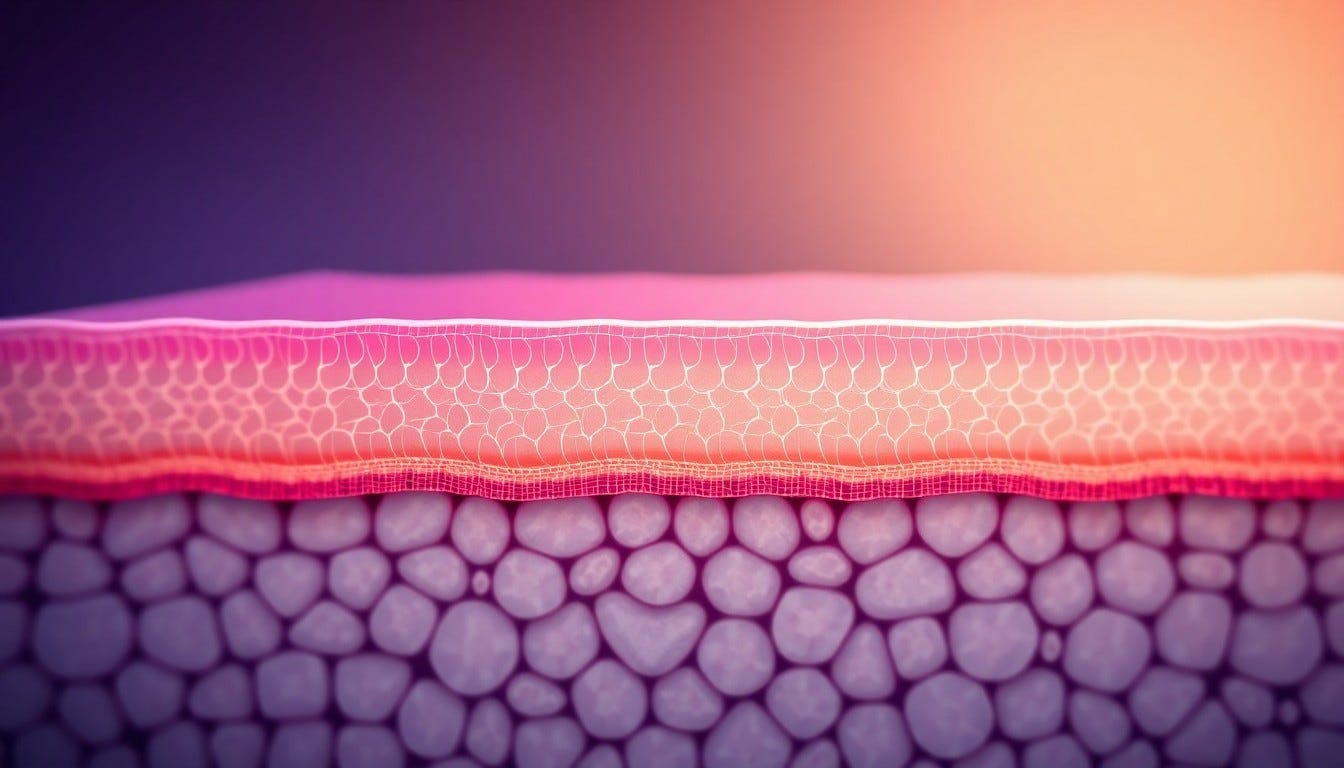
The basement membrane is exactly what it sounds like. It's a microscopic sheet — not even half a millimeter thick — that sits between the epidermis (the part you can see) and the dermis (the part the supplement companies are talking about). It's built almost entirely from one protein: Type IV collagen.
Type IV doesn't form ropy fibers. It forms a sheet of woven mesh, like the steel inside a concrete floor. Its job is to hold the surface to the foundation, control what passes between them, and provide a stable platform for the cells above and below to talk to each other.
When it works, skin looks alive. Nutrients flow up. Waste flows down. The signaling between fibroblasts and keratinocytes stays sharp. When it breaks down, the dermis can still be perfectly healthy and the surface will still look thin, fragile, and slow to heal — because the layer that connects the two has thinned out.
This is what I think most people mean when they say their skin "aged overnight." Nothing on the surface caused it. The scaffold underneath was failing for years and finally crossed the threshold where it started showing.
The Decline
A 1996 Munich study did something simple and useful: they biopsied skin samples across age groups and measured Type IV thickness at the dermal-epidermal junction. The pattern was clean. Visible thinning starts in the 30s. Noticeable drop after 50. By age 70, Type IV density is roughly half what it was at 25.
Three things drive it. UV light degrades Type IV faster than any other collagen in skin, because the basement membrane sits so close to the surface that it absorbs the radiation first. Oxidative stress fragments the mesh. And the fibroblasts that produce Type IV slow down about 1% per year after 30, which means even baseline replacement starts losing ground.
The cruel part of all this: it's invisible. You can't feel basement membrane thinning. You can't see it. You don't notice it until the surface starts behaving differently — bruising more easily, healing more slowly, looking thinner. By then the scaffold has been deteriorating for a decade.
The Supplement Industry Has Been Selling You One Floor
If you read the labels on most collagen products, you'll see Type I and Type III front and center. Sometimes Type II for joints. Almost never Type IV. Why?
Because you can't reliably take Type IV as a standalone supplement. Even if you could, your gut would break it down to amino acids before it reached your skin anyway. The body manufactures every type of collagen it needs from the same pool of building blocks — glycine, proline, hydroxyproline, lysine, plus trace minerals like sulfur and copper.
What 2025 research is starting to show is that when you give the body a steady supply of multi-source collagen peptides, it preferentially directs those amino acids toward whichever types are most depleted. A recent PLoS One trial found measurable basement membrane reinforcement in subjects taking 2.5g of multi-source collagen daily for 12 weeks. The body wasn't absorbing Type IV. It was rebuilding Type IV from the inputs it was given.
This is also, incidentally, why single-source collagens tend to underperform for skin. Marine-only or bovine-only gives the body one narrow input profile. The basement membrane needs the full spectrum.
What This Means in Practice
If you've been taking a single-source collagen and not seeing skin results after three months, the answer isn't to take more of the same. It's to look at what you're actually feeding the body.
I wrote a deeper breakdown of the five collagen types and what each one does, and the short version is this: Types I, II, III, IV, and V each do something different. The skin matrix needs all of them. Supplementing one in isolation is like trying to build a house with only rebar — strong in one dimension, useless overall.
The basement membrane is also the reason expensive topical products eventually stop working for some people. The actives can't cross a degraded membrane efficiently. You can spend more on serums, or you can repair the floor they're trying to travel through.

The Bottom Line
The dermis gets all the marketing. The basement membrane does all the structural work nobody mentions. Type IV collagen is the difference between skin that ages and skin that falls apart.
You can't see it. You can't isolate it. You can support it — by giving the body the full set of inputs it uses to rebuild it. That's the part most collagen routines miss.
Until next week,
Mark Edward